
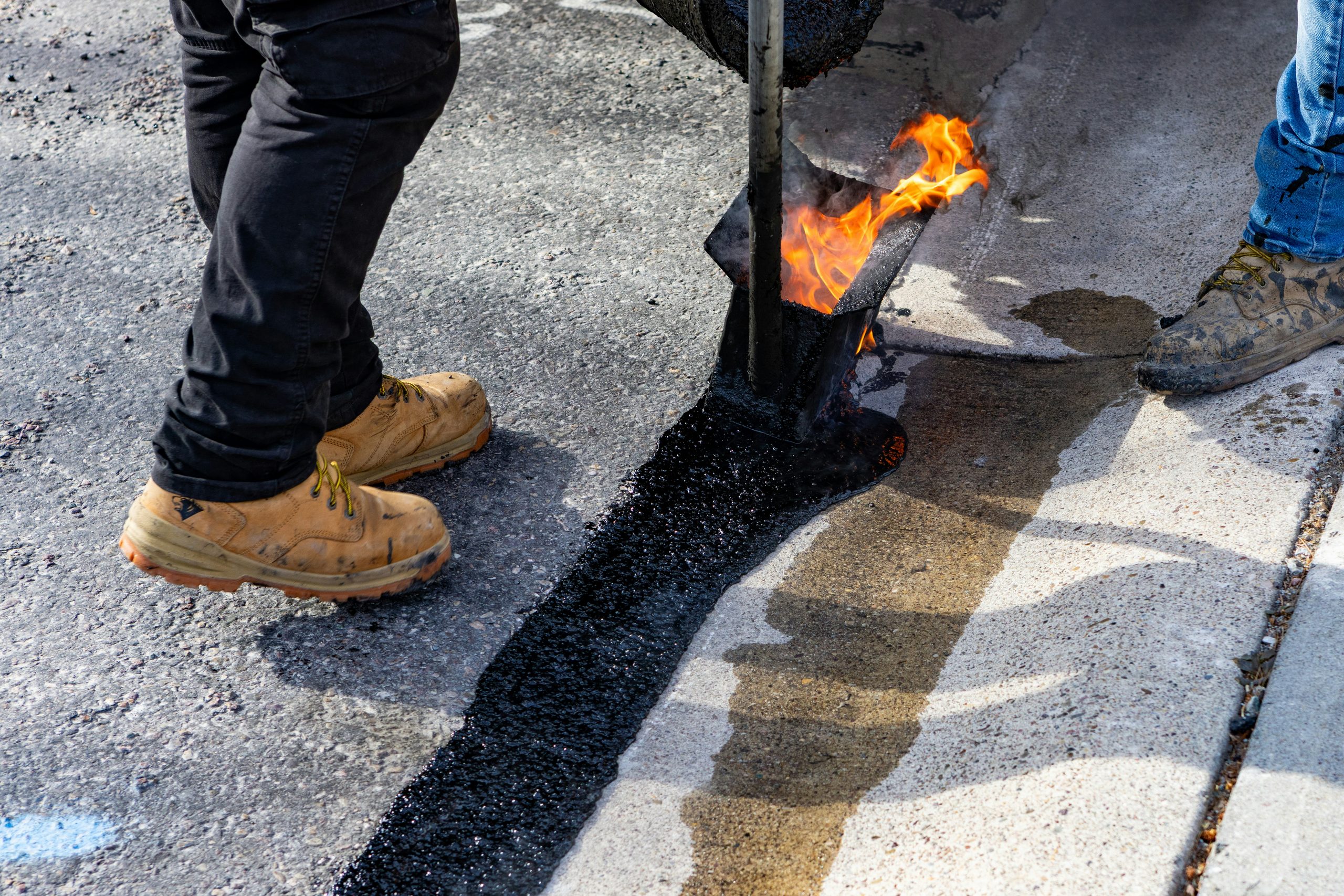
A highway is a stack of layers, each one cheaper and weaker than the one above it. At the bottom is the natural soil, shaped and compacted. On top come layers of crushed stone that spread the weight of traffic and let water drain away, and finally a surface of asphalt or concrete that gives grip, keeps rain out and can be renewed. Every layer takes the load from the one above, spreads it out and passes it down, so by the time it reaches the soil it is gentle enough not to sink it.
Build one yourself
Real highways are built from the ground up in a strict order. Step through the construction of an asphalt road, then switch to concrete and see what changes. Tick “Show the load” to watch a wheel’s weight fan out through whatever you have built so far.
Schematic, not to scale. Real thicknesses depend on the soil, the climate and the traffic the road is designed for.
What each layer does
California’s Highway Design Manual and the Pavement Interactive reference describe the same basic stack, from the top down:
- Surface course. The layer in contact with traffic, made from the highest-quality materials. It gives friction and smoothness and keeps surface water out of the layers below. On asphalt roads it is often split into a replaceable wearing course and a thicker binder course whose main job is to spread the load.
- Base. Durable aggregate, sometimes treated with cement or asphalt, directly under the surface. It adds load distribution and helps with drainage and frost resistance.
- Subbase. Lower-quality material than the base but better than the soil. It adds support, improves drainage and gives a working platform. Where the soil is good, it can be left out.
- Subgrade. The native soil or embankment fill that everything rests on, shaped and compacted, and sometimes treated to make it stronger.
Texas DOT’s pavement manual sums up the logic: a typical design is a series of layers that gradually decrease in material quality with depth. That makes economic sense, because each layer only has to cope with the load that the layers above have already spread out.
Asphalt or concrete?
Both work as layered systems, but they carry the load differently. Asphalt is called a flexible pavement because it bends slightly and relies on the layers beneath; concrete is a rigid pavement because the stiff slab itself spreads the load over a wide area.
| Feature | Asphalt (flexible) | Concrete (rigid) |
|---|---|---|
| Top layer | Asphalt courses: a binder course plus a wearing course | A single concrete slab; slabs in an FHWA study were 203 or 279 mm (8 or 11 in) thick |
| Joints | None needed | Sawn transverse joints; FHWA recommends a maximum spacing of 15 ft (4.6 m) for plain slabs |
| Load transfer | Through the layers below | Steel dowel bars across joints; 32 to 38 mm thick and 457 mm long in the FHWA study |
| Renewal | Wearing course can be milled off and replaced; “perpetual” designs aim for 50+ years without major rebuilding | Repairs focus on joints and individual slabs |
Why heavy trucks wear roads out
Pavement engineers measure traffic in equivalent single axle loads (ESALs). By convention, one pass of an 18,000-pound (80 kN) single axle counts as one ESAL. The idea comes from the AASHO Road Test, run in Ottawa, Illinois, from 1956 to 1960, which found that damage rises roughly with the fourth power of axle load. Later FHWA analysis suggests the true exponent is often closer to three, but either way the effect is dramatic: double the axle load and the wear goes up 8 to 16 times.
Axle load vs wear
Rules of thumb only. Real damage depends on pavement type and thickness, axle groups and tyres. FHWA notes that a 20,000 lb axle is about 1.5 ESALs under the fourth power rule.
Water: the quiet enemy
Water that soaks into the base and soil weakens them, so roads are shaped to shed rain fast. FHWA guidance says the normal cross slope on high-speed roads is 1.5 to 2 percent, falling from a crown at the centre. Texas DOT notes that drivers barely notice slopes up to 2 percent. The surface course is designed to keep water out, while the base and subbase help drain whatever gets in.
How roads fail
Questions people ask
How deep does a highway go?
AIt depends on the soil, the climate and the expected truck traffic. Engineers size every layer for the design traffic, measured in ESALs, so there is no single standard depth.
Why do concrete highways have lines across them?
AThose are sawn joints. Concrete shrinks and moves with temperature, so engineers cut it into slabs to control where cracks form, and put dowel bars across the joints to carry loads from slab to slab.
Is asphalt or concrete better?
ANeither always wins. Agencies such as Washington State DOT have formal policies for choosing the pavement type case by case, based on cost, traffic and conditions.
Why are roads curved slightly from the centre?
AThe crown and 1.5 to 2 percent cross slope send rainwater to the edges, keeping it out of the layers below and reducing standing water.
Can old roads be recycled?
AYes. California’s design manual notes that the base can be made from existing pavement layers recycled in place.
Sources
- Caltrans, Highway Design Manual, Chapter 600: Pavement Engineering.
- Pavement Interactive, HMA Pavement (layer roles, load spreading, perpetual pavements).
- Texas DOT, Pavement Manual: Flexible Pavement and Pavement Cross Slope.
- FHWA, Structural Factors of Jointed Plain Concrete Pavements: SPS-2 (slab thickness, dowels, joint spacing).
- FHWA Technical Advisory T 5040.30, Concrete Pavement Joints (archived).
- FHWA, Truck Size and Weight Study, working paper and Volume III, Chapter 5 (ESALs, fourth and third power).
- FHWA, Cross Slope (archived).
- FHWA, Concrete Pavement Construction (joint saw-cut depth).
- Wikipedia, AASHO Road Test (dates and location).
- WSDOT, Establishing a Uniform Policy for Selecting Pavement Type.
Spotted an error or have a question about this guide? Tell us and we will check it and update the page.
Leave a Reply