
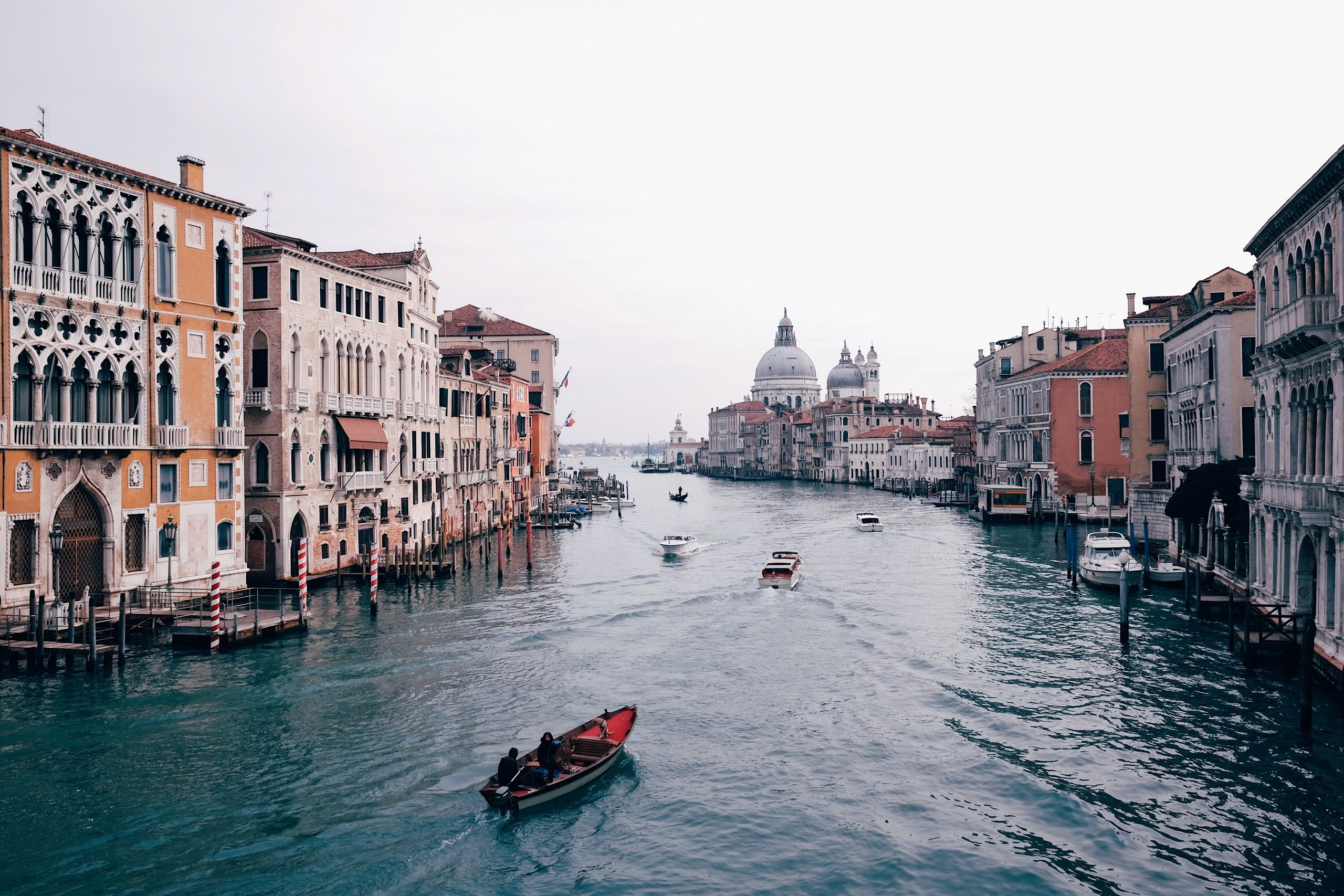
Venice sits on soft, waterlogged mud that could never carry stone palaces on its own. Builders drove huge numbers of short wooden piles very close together, which packed and stiffened the mud, then laid wooden planks and stone on top. Because the piles stay buried in wet, oxygen-poor ground, the fungi that normally rot wood can barely work. The wood is not immortal, though: slow-acting bacteria do eat into it over the centuries.
The Venice foundation, layer by layer
Most of a Venetian building is hidden below the waterline. Read the drawing from the top down:
Fig. 1 · Simplified cross-section, not to scale
- 1Brick wallsThe walls of the building itself, usually brick.
- 2Stone coursesCourses of stone at and below the waterline; in Venice this was often white Istrian stone, which copes well with brackish water.
- 3Wooden planksA platform of planks and beams laid across the pile heads to spread the load.
- 4Short piles, packed tightTypically 1 to 3.5 m long and 100 to 250 mm thick, with the gaps filled with sand.
- 5Soft silty clayThe weak, waterlogged lagoon soil that the piles compress and stiffen.
- 6Stiffer layerFirmer ground deeper down. Research shows the short piles rarely reach it.
Why short piles instead of deep ones
A popular explanation says the piles were hammered down until they hit a hard layer. Engineering studies of real Venetian foundations tell a more interesting story.
Each pile is a column standing on solid ground, like the legs of a table.
Piles were short and tightly spaced to improve the soft clayey silt itself and reduce settlement. They rarely reach stiffer layers, and they do not add much load-bearing capacity on their own.
Geotechnical engineer Paolo Simonini and colleagues at the University of Padua describe it this way: driving so many small piles into the shallowest layer compacts it, turning a soft mud into a much stiffer block. The piles and the packed soil work together; the 2025 TU Delft and Padua study calls them short friction piles, which carry load mainly along their sides rather than at their tips. Simonini’s computer models also show what happens if the wood weakens: the load gradually shifts from the piles to the surrounding soil.
Why the wood did not simply rot
Wood is attacked by three kinds of organism, and each needs different conditions. That is why where a pile sits matters more than how old it is.
| Attacker | Needs | Where in Venice | Speed |
|---|---|---|---|
| Decay fungi | Oxygen | Pile tops exposed to air when water levels drop | Fast once exposed |
| Erosion bacteria | Water; work even without oxygen | Piles buried in waterlogged mud under buildings | Slow, over centuries |
| Shipworms | Salt water and open water | Mooring poles (briccole) standing in the canals and lagoon | Rapid, worse since 2013 |
A 2025 study by researchers from TU Delft and the University of Padua sums up the buried case: fungal attack in submerged piles progresses very slowly because there is so little oxygen, while erosion bacteria can still slowly wear away the walls of the wood fibres. Fully submerged piles can therefore last for centuries before their load-bearing capacity drops substantially. The researchers also warn that where water levels fluctuate, exposed pile tops meet oxygen and fungal decay speeds up.
Real samples back this up. When researchers dated and tested the alder footings under the Rialto Bridge, radiocarbon dating identified two construction periods, the earlier one around the year 1000, and the wood was in good overall condition, with only one sample showing severe bacterial attack.
Test yourself: rot or not?
Six piles, six situations. Pick what you think happens, then read the explanation and its source.
Venice and Amsterdam: same idea, different piles
Amsterdam is the other great city on wooden piles, and the 2025 TU Delft and Padua study compared the two:
Venice
- Length
- About 1 to 3.5 m, short friction piles
- Diameter
- About 100 to 250 mm
- Wood
- Mostly alder and larch; less often oak, elm and pine
- Checking
- Small samples examined under the microscope and tested in the lab
Amsterdam
- Length
- Typically 10 to 12 m
- Diameter
- About 180 to 200 mm at the head
- Wood
- Mainly spruce, pine and fir; less alder and oak
- Checking
- Fast underwater micro-drilling of the piles in place
The researchers suggest Venice could adopt Amsterdam’s micro-drilling method to check far more piles, far faster.
Questions people ask
Is Venice floating?
No. Its buildings stand on foundations driven into the lagoon soil. Britannica describes the city as resting on a vast number of densely packed wooden piles driven into the mud and clay.
What wood did they use?
A study of samples from five of Venice’s six districts found a small group of species: alder, larch, oak, pine, elm and spruce, the last probably introduced more recently.
Are the numbers of piles exact?
The figures of about 1.1 million piles under the Salute and 12,000 under the Rialto are repeated in many sources, including a Slovenian technical article. They come from historical records and cannot be checked without digging, so treat them as traditional figures.
Will the piles last forever?
No. Bacteria slowly degrade even buried wood, and research in Padua links that decay to some building settlements. The slow pace is what has given Venice centuries.
Why do the poles in the canals look so worn?
Mooring poles stand in open water, where shipworms can bore into them. A 2025 study reports that warm-water shipworms, present since 2013, are especially aggressive.
Next time you are in Venice
- Look at the base of buildings along a canal: the band of pale stone at the waterline is the stone base that sits on the hidden wooden foundation.
- Check the wooden mooring poles at boat stops: their worn, narrowed sections near the water show what open water does to wood.
- Stand in front of Santa Maria della Salute and picture the forest of piles beneath it.
- Cross the Rialto Bridge, whose oldest footings date back roughly a thousand years.
Sources
- Pagella, G. et al. (2025), Traditional wooden foundation piles in Amsterdam and Venice, Wood Material Science and Engineering (TU Delft repository).
- Simonini, P., Long-term behavior of historical building foundations, Taylor and Francis.
- Ceccato, F. and Simonini, P. (2013), Long-term mechanical behavior of wooden pile foundation in Venice, University of Padua.
- Macchioni, N., Pizzo, B. and Capretti, C. (2016), An investigation into preservation of wood from Venice foundations, CNR.
- The wooden foundations of Rialto Bridge in Venice: technological characterisation and dating (2019), Journal of Cultural Heritage.
- Pagella, G. and Urso, T. (2025), Material and environmental factors impacting the durability of oak mooring piles in Venice, Sustainability.
- Encyclopaedia Britannica, How was Venice built on water?
- Slovenian technical article via dLib.si, Venetian piles (traditional pile counts).
- Visit Italy, How Venice was built (Istrian stone above the planks).
Spotted an error or have a question about this guide? Tell us and we will check it and update the page.
Leave a Reply