
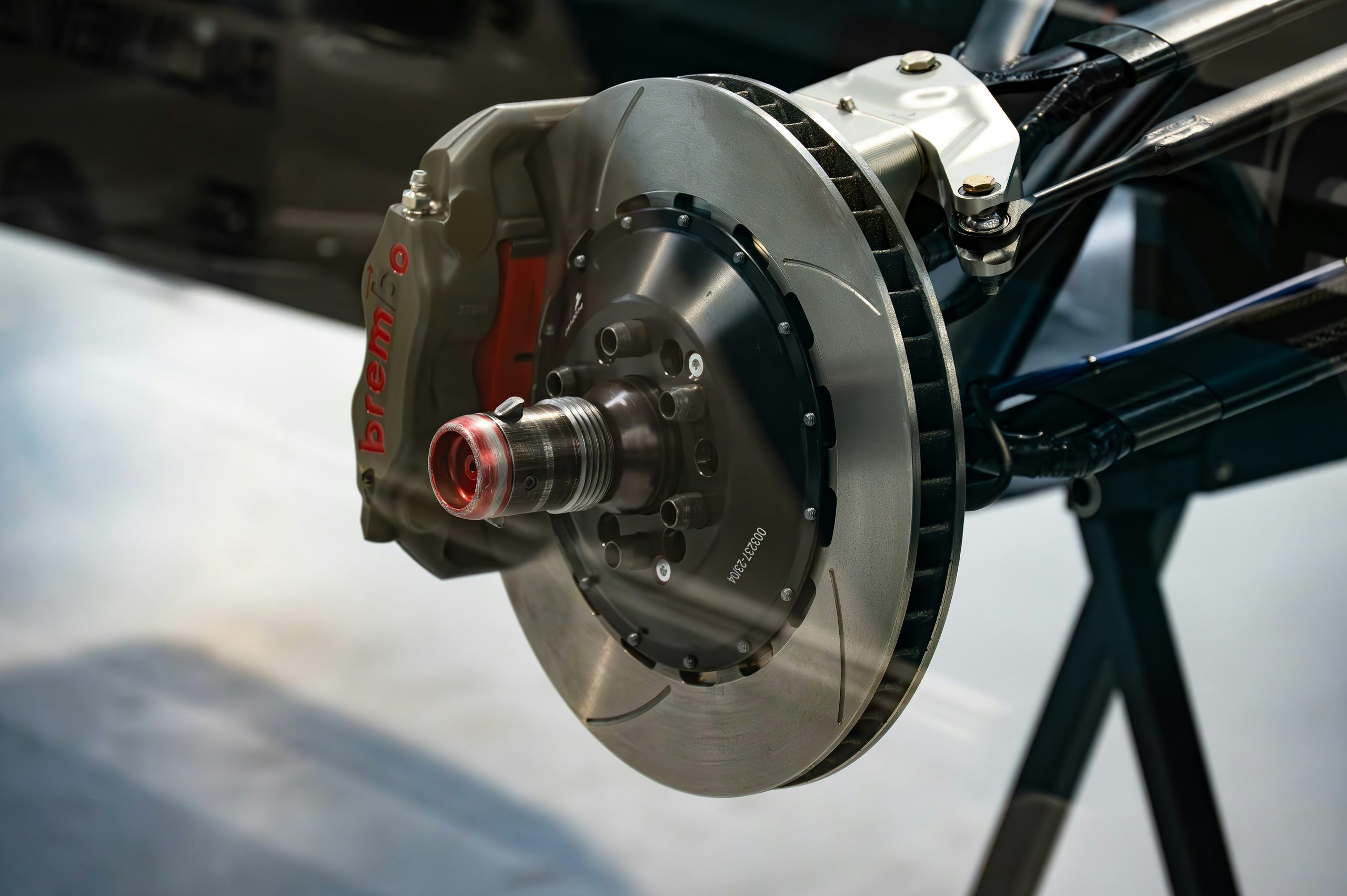
A car pulls out ahead of you. You stamp on the brake as hard as you can. Without help, the front wheels would stop turning almost instantly and the car would slide straight on, no matter which way you turn the steering wheel.
Short answer: ABS stops that from happening. Sensors watch every wheel; when one starts slowing much faster than the car, a computer briefly lets the pressure off that brake, then puts it back on, many times a second. The tyre stays just below the point where it would lock, so it keeps gripping and, above all, keeps steering.
Why a locked wheel is bad news
When you brake, the tyre turns a little slower than the car is moving. Engineers call the difference slip: 0% is a freely rolling wheel, 100% is a wheel that has stopped turning while the car slides. A 2005 NHTSA test report explains that every tyre has an optimum slip that produces the most braking force, and that on dry asphalt it lies between 10 and 20%, usually lower on wet, slippery surfaces.
Push past that peak and things go wrong fast. The same report notes that once the maximum braking force is exceeded, the wheel goes from optimum slip to fully locked in about a tenth of a second. A locked tyre slides instead of grips, and it can no longer push the car sideways. That is the real danger: as Bosch puts it, locking wheels make the vehicle unsteerable.
Fig. 1 · Grip versus slip, illustrative shape
The curve shapes are illustrative; real values depend on the tyre and the road. The 10 to 20% window is NHTSA’s figure for dry asphalt.
The four parts of an ABS
An anti-lock system works with your normal brakes rather than replacing them. It adds four things:
Replay a panic stop
Run the same emergency stop with and without ABS. Drag the slider to move through it moment by moment, and watch what the valves are doing. Tick “Steer left” to see why control matters more than distance.
Top view of the car’s path.
Press Play or drag the slider.
Illustrative model, slowed down so you can follow it. It uses NHTSA’s 10 to 20% slip window and 0.1 s lockup time; real systems cycle much faster, up to 40 times a second according to Bosch. It does not predict real stopping distances.
Does ABS make you stop shorter?
Sometimes, but that is not its main job. NHTSA’s consumer guidance says ABS is designed to help you keep control during emergency braking, not necessarily to stop the car more quickly. How it compares with locked wheels depends on the surface:
| Surface | Stopping distance with ABS | Why |
|---|---|---|
| Wet or slippery pavement | Often shorter | NHTSA says ABS may shorten stopping distances here, the conditions where wheels lock most easily. |
| Dry pavement | Usually shorter or similar | NHTSA says most systems may shorten distances on dry roads too. You must press very hard before ABS even activates. |
| Ice and packed snow | Varies | ABS activates almost immediately. Its gain is mainly steering control. |
| Gravel or loose snow | Can be longer | A locked tyre ploughs a wedge of loose material in front of it, which helps it stop; ABS prevents that, as Mazda’s owner’s manual explains. |
What the crash data shows
NHTSA’s long-term study of crashes from 1995 to 2007 gives a nuanced picture:
The report’s conclusion was that ABS on its own helps most in everyday crashes, and that pairing it with electronic stability control, which is built on top of ABS, prevents a large share of both fatal and non-fatal crashes.
How to brake in a car with ABS
What you will feel: the pedal pulsing under your foot, and buzzing or grinding from the valves. Both are normal and mean the system is working. Honda’s manuals add that ABS stops working below about 6 mph (10 km/h), where a wheel can no longer lock dangerously.
A short history
The first system was an optional extra. Today ABS is the foundation that traction control and electronic stability control are built on.
Quick questions
ABS keeps each tyre just short of locking by releasing and restoring brake pressure many times a second, so you can keep steering while you brake as hard as you can.
Sources
- NHTSA, Light Vehicle ABS Performance Test Development, DOT HS 809 747, 2005 (slip definition, 10 to 20% optimum, 0.1 s lockup).
- NHTSA, The Long-Term Effect of ABS in Passenger Cars and LTVs, DOT HS 811 182, 2009.
- NHTSA, Antilock Braking Systems: Traffic Safety Tips, 1996 (how ABS works, do not pump, pedal pulsing).
- NHTSA, Antilock Brake Systems (ABS) consumer questions, archived copy (stopping distances by surface).
- Bosch Mobility, Antilock braking system.
- Mercedes-Benz press release via Automotive World, World premiere in 1978 in the Mercedes-Benz S-Class.
- Zwischengas, 50 years ago: Bosch anti-lock braking system ready for production (inductive sensors, 1967).
- Honda owner’s information, Anti-lock Brake System (ABS) ABS from 6 mph and tyre size notice.
- Mazda USA, Antilock Brake System owner’s manual page (loose surfaces).
This guide explains how ABS works. Always follow your vehicle’s owner’s manual. Spotted an error? Tell us and we will check it.
Leave a Reply