
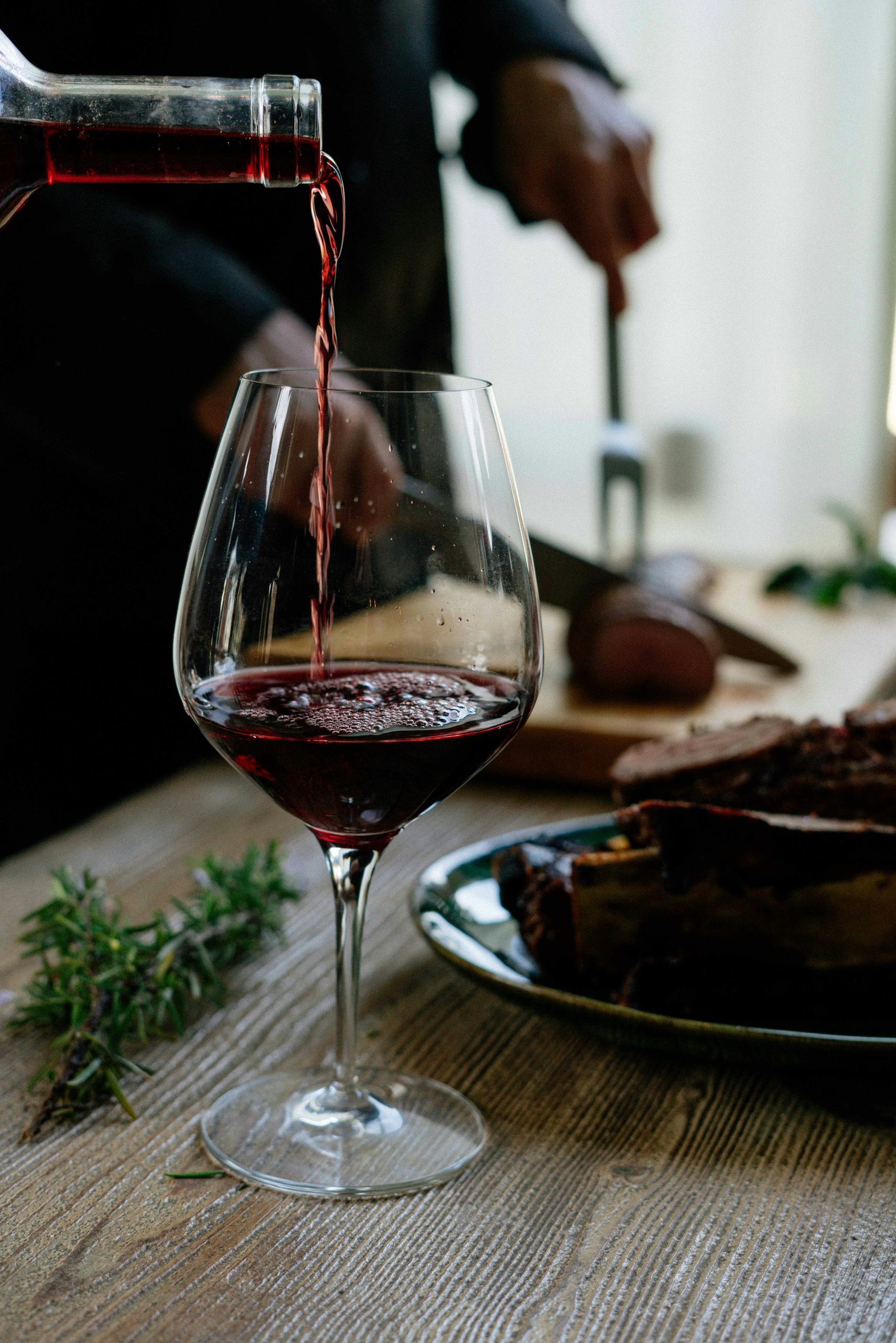
Next time you sip a young red wine or a strong black tea, run your tongue along the inside of your top lip a few seconds later. It drags instead of gliding. Nothing has been taken out of your mouth; the slippery coating that is normally there has stopped working.
Short answer: red wine feels drying because of tannins, compounds from grape skins, seeds and oak. They bind to the proteins in your saliva that normally keep your mouth slippery. As those proteins clump together and drop out of the coating, friction goes up and your mouth feels dry and rough. Scientists call this sensation astringency.
It is not a taste, it is a touch
Sweet, sour, salty, bitter and umami are detected by taste receptors. Astringency is different. The Society of Sensory Professionals notes that most studies support the idea that astringency is primarily a tactile sensation: something your mouth feels, the way your fingers feel sandpaper. That is why you notice it on your gums and the inside of your cheeks, not only on your tongue.
Researchers still argue about the exact mechanism. A 2024 review in OENO One concludes that it is not fully settled, and other reviews list several effects that probably happen at once: proteins clumping into tiny gritty particles, the salivary film on your mouth’s surfaces breaking up, saliva losing its lubricating power, and nerve endings in the lining of the mouth responding directly. The common thread is lost lubrication, which is why food scientists now measure astringency with tribology, the engineering science of friction.
Your mouth runs on a lubricant, and tannins are very good at taking it out of service.
Two different meanings of “dry”
Wine labels add to the confusion, because “dry” on a bottle means something else entirely.
Dry on the label
Refers to sugar. Under EU wine rules, still wine may be labelled dry if it has no more than 4 grams of sugar per litre, or up to 9 grams if it is acidic enough.
Measured in a lab · about sweetnessDry in your mouth
Refers to astringency: the rough, puckering feel caused mainly by tannins. A wine can be sugar-dry yet soft, or slightly sweet yet grippy.
Felt by touch · about tanninsWhere the tannins come from
The big difference between red and white wine is not the grape colour but how long the juice spends with the solid parts of the grape.
- Crushingday 0
Grapes are broken open. Tannins sit mostly in the skins and seeds, not in the juice.
- White wine: pressing firstwhite wines
For most whites the juice is separated from the skins before fermentation, so very little tannin gets in.
- Red wine: macerationdays to weeks
Reds ferment with their skins and seeds. The Australian Wine Research Institute notes that skin tannins come out first and seed tannins later in maceration, and skin tannins are extracted more easily than seed tannins.
- Oak barrelsmonths
Ageing in oak can add a second family, hydrolysable tannins, on top of the grape tannins.
- In the bottleyears
Once extracted, grape tannins keep rearranging chemically, so the wine’s tannins can differ from the grape’s original ones.
Inside your mouth: the sip simulator
This simplified model shows the chain of events on the surface of your tongue. Pick a drink, take sips, and try the things tasters use to reset their mouths. It reproduces the behaviours found in the studies cited below, but the numbers on the gauges are illustrative, not measurements.
Illustrative model. It follows the published findings that astringency builds over repeated sips, that saliva gradually replaces lost proteins, that fatty foods counter the dry feel and that crackers clear it better than water. Real intensity depends on the drink and the person.
What turns the dryness up or down
Sensory scientists have tested many of the things wine lovers argue about. Here is what the studies we checked found:
| Factor | Effect | What the research found |
|---|---|---|
| Taking several sips | Stronger | Peak astringency and the time to reach it both rose over six successive sips of red wine (Ross and colleagues, 2007). Astringency also takes more than 15 seconds to fully develop. |
| Fatty food | Weaker feel | Researchers at the Monell Chemical Senses Center found that astringent and fatty sensations sit at opposite ends of a lubrication scale, which helps explain why red wine and steak feel balanced together (Peyrot des Gachons and colleagues, 2012). |
| Crackers between sips | Weaker | Of four palate cleansers tested, unsalted crackers cut perceived astringency best; plain water was the least effective. |
| Acidity | Stronger | The 2024 OENO One review notes that astringency rises as pH falls: the more acidic the wine, the more astringent it feels. |
| Your own saliva | Varies | People differ. Studies cited in a 2025 Food and Function paper found that people whose salivary protein levels held steady reported less astringency, while those who failed to replenish them reported more, especially over repeated tastings. |
Same feeling, other foods
Red wine is the famous example, but the Society of Sensory Professionals lists several others. Polyphenols are the most common cause, though acids, metal salts such as alum and alcohol can also be astringent.
Questions people ask
Is it the alcohol that dries my mouth?
Mostly not. Alcohol can add to astringency, but the rough, gripping feel of red wine comes mainly from tannins binding salivary proteins. Many white wines have similar alcohol levels and far less of that feel.
Why does the dryness get worse as I keep drinking?
Each sip pulls more proteins out of your saliva, and your mouth needs time to replace them. Lab tests show peak astringency rising with repeated sips.
Does water help?
Only a little. In a palate cleanser study, water was the least effective option, while plain crackers worked best.
Why does red wine go so well with cheese or steak?
Fatty foods feel slippery and astringent drinks feel dry. Monell researchers found the two sensations oppose each other, so together they leave your mouth feeling balanced.
Is a “dry” wine on the label more drying in the mouth?
Not necessarily. “Dry” on the label is about sugar. The drying feel is about tannins, so a tannic red and a soft red can both be labelled dry.
Key takeaways
- The dry feeling is astringency, a sense of touch rather than taste.
- Tannins bind to the proteins that lubricate your mouth, and friction goes up.
- Red wines get their tannins from skins, seeds and oak; most whites are pressed off the skins first.
- It builds with each sip; fatty food and crackers tone it down better than water.
Sources
- Kuhlman, B. A. et al. (2024), Astringency perception in a red wine context: a review, OENO One.
- McRae, J. M. and Kennedy, J. A. (2011), Wine and grape tannin interactions with salivary proteins and their impact on astringency, Molecules.
- Laguna, L. and Sarkar, A. (2017), Oral tribology: update on the relevance to study astringency in wines, Tribology: Materials, Surfaces and Interfaces.
- Society of Sensory Professionals, Astringency.
- Australian Wine Research Institute, Impacts of winemaking practices on tannin in red wines and Measuring wine tannins fact sheet.
- Commission Delegated Regulation (EU) 2019/33, Annex III, sugar content terms.
- Ross, C. F. et al. (2007), Efficacy of palate cleansers for reduction of astringency carryover during repeated ingestions of red wine, Journal of Sensory Studies.
- Cell Press (2012), Why wine and tea pair so well with a meal, on Peyrot des Gachons et al., Current Biology.
- Velázquez-Martínez, R. I. et al. (2025), Time-dependent changes in the early salivary proteome after oral stimulation with wine, Food and Function.
Spotted an error or have a question about this guide? Tell us and we will check it and update the page.
Leave a Reply