
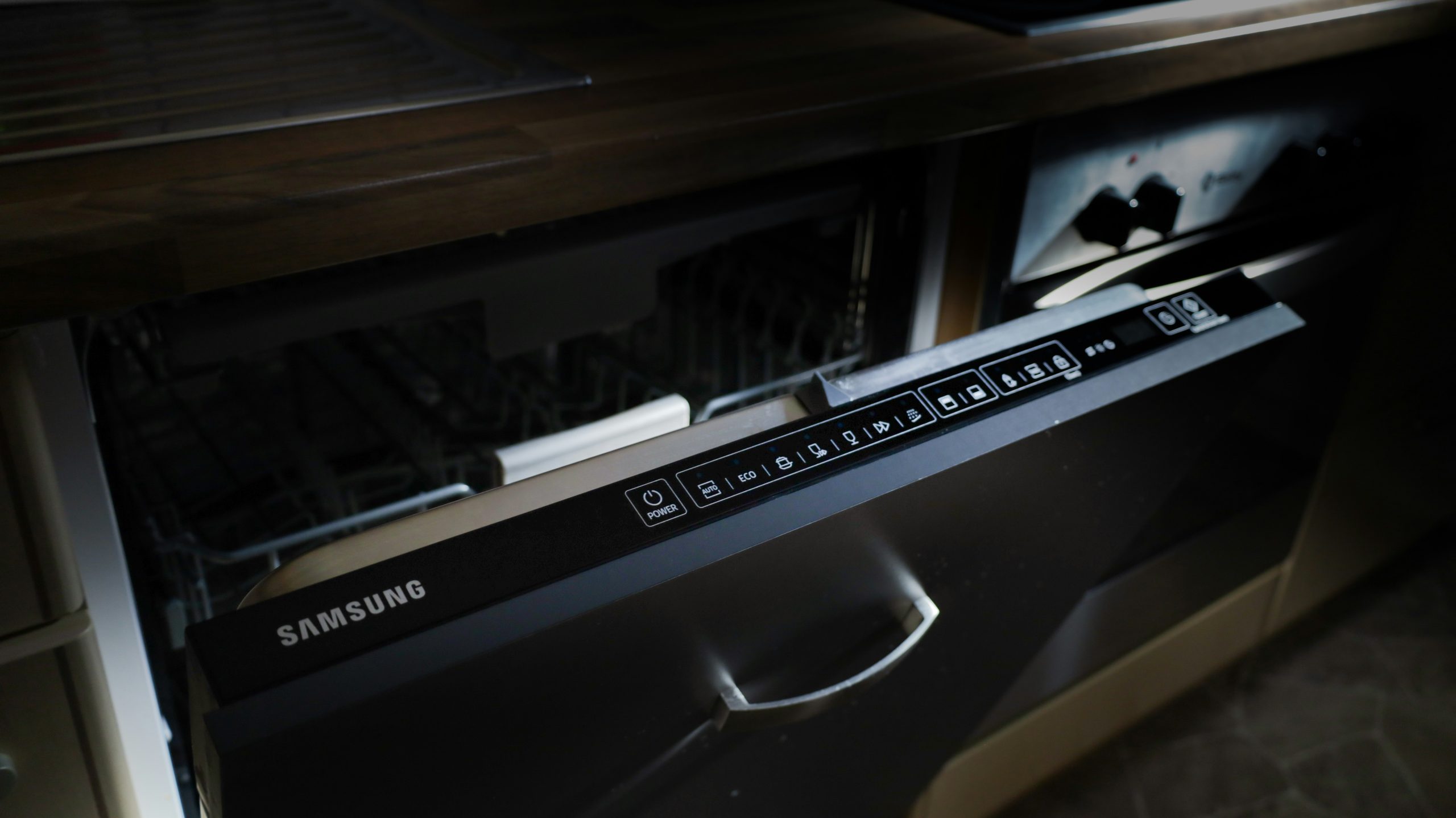
“A few plates in the sink must use less water than running a whole machine.”
In a University of Bonn lab test, people washing 12 place settings by hand used an average of 103 litres. A dishwasher on its normal programme used 15 litres.
A dishwasher never fills its tub. It puts a few litres into a small well at the bottom, heats it, and pumps that same water through spinning spray arms again and again, filtering it on every pass. Heat, strong detergent and long contact time do the scrubbing that your hands do at the sink, so the machine only needs fresh water for a handful of short fills.
Follow the water: one fill, six stops
Picture the inside of the machine as a tiny water park rather than a bath. Tap a stop to highlight that part of the drawing.
Fig. 1 · Simplified front cutaway
The key idea is recirculation. Within one phase of the programme, the same few litres travel the loop from basin to pump to arms to dishes and back many times. Fresh water is only needed when the machine moves from one phase to the next: pre-wash, main wash, rinses. GE Appliances, for example, describes its machines filling only to a level just below the fine filter cap.
Why a few litres are enough
Cleaning chemists describe any wash with four levers, known as Sinner’s circle after the chemist Herbert Sinner: mechanical action, temperature, chemistry and time. Turn one down and you have to turn another up to get the same result. Miele uses it to explain the difference between the sink and the machine: at the sink, scrubbing does most of the work, while a dishwasher makes up for its gentler mechanical action with stronger detergent and longer programmes.
The slices are illustrative, to show the balance Miele describes, not measured values.
This is also why the Eco programme takes so long. It saves energy by running cooler and saves water by filling less, then pays for both with time. In the UK study below, the Eco 50°C programme ran for about two and a half hours.
What the lab tests actually found
Researchers at the University of Bonn have measured this for years by giving volunteers the same pile of soiled dishes and letting them wash the way they do at home. A 2022 review of that work, by Lotta Schencking and Rainer Stamminger, collects the main results:
Two things stand out. First, the machine is remarkably consistent, while hand washing swings wildly from person to person and country to country. Second, the review notes that large differences in water use did not produce big differences in how clean the dishes ended up: careful hand washers can be frugal, but most people are not.
Try it: your sink against the machine
Enter how you wash by hand, pick a dishwasher, and see how the water compares for one load and over a year. If your machine’s yellow EnergyGuide label lists gallons per cycle, choose “From my label” and type it in.
Sink vs machine water meter
Interactive · Fig. 2
At the sink
In the machine
How the limits have tightened
In the United States, the Department of Energy caps how much water a new dishwasher may use, and the ENERGY STAR label sets a stricter bar. The ENERGY STAR label is also used in Canada. The current figures:
| Rule | Machine size | Water per cycle | Energy per year |
|---|---|---|---|
| Original statutory standard | Standard | 6.5 gal (24.6 L) | 355 kWh |
| US federal standard, made from May 30, 2013 | Standard | 5.0 gal (18.9 L) | 307 kWh |
| US federal standard, made from May 30, 2013 | Compact | 3.5 gal (13.2 L) | 222 kWh |
| ENERGY STAR, from July 19, 2023 Strictest | Standard | 3.2 gal (12.1 L) | 240 kWh |
| ENERGY STAR, from July 19, 2023 | Compact | 2.0 gal (7.6 L) | 155 kWh |
“Standard” means room for at least 8 place settings plus 6 serving pieces; “compact” holds fewer. For comparison, the federal limit for a kitchen tap is 2.2 gallons (8.3 litres) per minute, so a whole ENERGY STAR cycle uses about as much water as one and a half minutes of a fully open tap.
Getting the most from each cycle
The machine is efficient, but habits can undo it. These are the points the Bonn review highlights:
- Scrape, do not rinse. Studies cited in the review estimate that rinsing dishes by hand before loading uses around 100 litres, while the machine’s own pre-rinse uses about 4.
- Run it full. In the UK lab test only a third of people managed to fit all 140 items in; most left some out. Home studies also found machines are usually run below capacity.
- Choose Eco when you are not in a hurry. It saves the most water and energy, but the saving shrinks if you pre-rinse by hand as well.
- Keep the filter clean. Every fill passes through it many times, so a clogged filter means dirty water being sprayed back onto your dishes. Your manual shows how to remove it.
Quick questions
Does a dishwasher reuse dirty water?
Within one phase, yes: the same water is filtered and pumped round again and again. Between phases it is drained, and the final rinse uses fresh, clean water.
Is a dishwasher more hygienic than hand washing?
Older studies summarised in the Bonn review found machine-washed items carried far fewer bacteria, and a 65°C programme was very effective at removing them. Hand-washed results varied hugely.
Why does my dishwasher run for hours?
Long programmes, especially Eco, swap heat and water for time. Soaking at a lower temperature loosens food with less energy, which is Sinner’s circle at work.
Is it worth running half a load?
A half-empty cycle uses close to the same water as a full one. Waiting until the machine is full gives you the best water and energy per plate.
How do I know how much water my machine uses?
In the US, the yellow EnergyGuide label and the ENERGY STAR product finder list gallons per cycle. Your manual may list figures for each programme.
Can hand washing ever use less water?
Yes, if you wash in a filled bowl and rinse sparingly. The lab studies show some people manage it, but the average hand washer uses several times more.
What to do tonight
Scrape the plates into the bin, load the machine until it is genuinely full, pick Eco if you can wait until morning, and leave the tap off. The dishwasher will use a few litres, pump them round dozens of times, and do the job with less water than a couple of minutes at the sink.
Sources
- Schencking, L. and Stamminger, R. (2022), Manual and electric dishwashing: a review, Tenside Surfactants Detergents (lab and consumer studies, pre-rinsing, loading, hygiene).
- U.S. Department of Energy, Residential dishwashers energy conservation standards.
- ENERGY STAR, Dishwashers key product criteria (effective July 19, 2023).
- U.S. Department of Energy, Water conservation standards for faucets (2.2 gpm at 60 psi).
- Natural Resources Canada, Faucets regulations (kitchen faucets 1.8 gpm).
- Miele, Sinner’s Circle: for a hygienic wash cycle.
- GE Appliances, Circulation system with alternating spray arms.
- Reckitt Finish, How does a dishwasher work? (heating, dispensing, recirculation, rinse).
- HowStuffWorks, How dishwashers work (spray arms turned by the water, like a sprinkler).
Spotted an error or have a question about this guide? Tell us and we will check it and update the page.
Leave a Reply